Friday, October 12, 2018

A superlative cast, music of finesse and a seamlessly beautiful staging in Victorian Opera's Pelléas et Mélisande


It took until 1977 for Pelléas and Mélisande, Claude Debussy’s sole operatic output that reached the stage in its premiere at the Opéra Comique in Paris in 1902, to receive its first professional staging in Australia. That was in the heftier days of the state opera company, then known as Victorian State Opera under the late Richard Divall. With the now revived Victorian Opera in its 11th year, it’s welcome to see Debussy’s unique and poetically eloquent work presented to a new audience. On top of that, at the majestic Palais Theatre for its opening on Thursday night, it was refreshing to see that the audience included a generous percentile of young attendees half my age - and I haven’t even gone grey yet.

Angus Wood as Pelléas and Siobhan Stagg as Mélisande
Perhaps that was, in part, due to the drawing power of the company’s new associations with young blood from the Australian National Academy of Music (ANAM). Conductor and Artistic Director of Victorian Opera Richard Mills must be as proud as punch with the more than 60 ANAM pit musicians for they played the score’s seeping transparent soundscape with the utmost finesse, fine balance and even support - musically and artistically, a winning collaboration.

So too was the seamless beauty achieved by director Elizabeth Hill and her creative team in delivering production standards second-to-none. Set and costume designer Candice MacAllister’s clever, elegant and unfussy designs worked a treat in capturing the multiple scene shifts. Three moveable and mirrored bayed pods easily evoked the exterior and various rooms of the castle in the story’s mythical kingdom of Allemonde, working a treat in capturing every one of 15 of them over its 5 acts. Though not always literal in reflecting the duality of light and dark that resides in the storytelling, no one could doubt the power and indispensability of Joseph Mercurio’s stunning palettes of aqueous lighting to the overall effect. 

Despite lacking set arias, ensemble and melodious threads, the work’s approachability comes gently, like a slow-growing creeper waiting for spring to bloom while, advancing through its branches, a poison begins to take affect - a work that paints a picture that stretches well beyond its own canvas. 

Samuel Dundas as Golaud and Siobhan Stagg as Mélisande
Based on the 1892 play by Maurice Maeterlinck, the subject of Pelléas et Mélisande is a love triangle set in a vaguely Medieval world, somewhat like Wagner’s Tristan und Isolde which Debussy had seen in Bayreuth. Contrasts and opposites feature large - between man and woman, light and dark, blindness and shadow, the natural world and human nature, of truth and the unspoken as part of its infused symbolism. These contrasts play out within something of a domestic drama. Widowed older brother (Golaud), whose grandfather (King Arkel) has marriage plans already in place, marries young mysterious beauty (Mélisande). Younger half-brother (Pelléas) and said beauty fall in love. The dramatic course changes abruptly when Mélisande loses her wedding ring, Golaud unreasonably demands that she retrieve it in the dark of night and take Pelléas with her for protection. 

To bring life to the characters, Victorian Opera have assembled a superlative cast.  Pelléas and Mélisande carry the opera’s title but Golaud is a formidable hinge and a complexly depicted force. Baritone Samuel Dundas gave a brilliant interpretation of the character, exploring Golaud’s seemingly kind and harmless beginnings and increasing volatility and suspicion. Dundas, solid and sure in voice, brought excitement to every scene, especially at his rise in rage with his son Yniold - an endearing bright-voiced Sophia Wasley - in which, trying to get blood out of a stone, he uses his son as a tool in Act 3.

Seen more often on Berlin’s Deutsche Oper stage, it was a coup in having the exquisitely nuanced Australian soprano Siobhan Stagg back home to give a beguiling debut in the role of Mélisande. Stagg brought layers of colour to Mélisande’s character and vocal splendour to match. Stagg’s gestures captured the enigmatic, curious and playful to the tender, distant and despondent young woman who succumbs to a tragedy she fears unavoidable, the voice’s liquid class and affecting iridescence one hopes to see back in Melbourne again soon. 

Liane Keegan, David Parkin, Siobhan Stagg and Sophia Wasley


As her Pelléas, warm and resonant Australian tenor Angus Wood, who likewise has a growing international career, brought together a fine combination of manliness and innocence to the role. Together with Stagg, the pair built their affections gradually, with understanding and a slice of ambiguity that one always feels pervades the story. Their Act 4 encounter, when Mélisande lets her hair down from the tower for Pelléas to caress, provided not only a climax in their romantic discoveries and vocal current, but was deftly resolved with a long ribbon unfurling from the heights which Pelléas took hold of and splitting into three parts with each manipulated by a dancer.

David Parkin becomes more and more a marvellous interpreter and his deeply creviced and flinty bass was in its finest form as King Arkel. As the king’s supportive wife Geneviève, Liane Keegan’s plush and impactful vocals added broad support and fresh from the Herald Sun Aria Final, baritone Stephen Marsh gave a strong performance as the Physician in the final scene - a highlight of dramatic interplay as Mélisande takes her last breath. 

With just two performances, Victorian Opera’s Pelléas et Mélisande will all but disappear quickly but it’s seductive and ethereal quality will last long after as one to remember for those fortunate to experience it. 


Pelléas et Mélisande
Victorian Opera
Palais Theatre 
Until 13th October, 2001


Production Photos: Jeff Busby


Wednesday, October 10, 2018

Soprano Rebecca Rashleigh soars with dedication and composure to win the Herald Sun Aria: Herald Sun Review

Published in print in edited form on 11th October, 2018.


The excitement and unpredictability of competition in the Herald Sun Aria Final ended on Tuesday night with Melbourne soprano Rebecca Rashleigh taking out a well-deserved first prize. Amongst a field of five finalists singing for cash prizes totalling $60,000, Rashleigh’s composure, dedication and unforced technique graced the Melbourne Recital Hall. And just as gracious came an acceptance speech that rattled emotions.


Rebecca Rashleigh making her acceptance speech, Herald Sun Aria Final
In a two-part evening, each finalist sang one aria in the first part and, in the same order, presented a second in part two. Judges Dobbs Franks, Tiffany Speight and Greg Hocking, who conducted the Melbourne Opera Orchestra as part of the prize’s new partnership, had the difficult task in selecting a winner. 

Rashleigh began with Liù’s plea to Calaf from Turandot, “Signore, ascolta!”, and invested it with eloquence and heartfelt meaning. In her second, Rashleigh rendered the delicacy and luminosity of “Song to the Moon” from Rusalka with angelic beauty and deep sincerity. With it came assured phrasing, dexterous filigree work and a scintillating top. Rashleigh now joins acclaimed winners that include Kiri Te Kanawa (1965), Daniel Sumegi (1987) and Nicole Car (2007).

Two other sopranos (Tessa Hayward and Ruth Blythman) and two baritones (Stephen Marsh and Michael Lampard) performed with notable commitment and class. 

Taking out the Dame Elizabeth Murdoch Prize, Hayward sang Gilda’s “Caro nome” from Rigoletto with especially affecting innocence and fine technique. Lampard’s utter conviction to his character was marvellous to witness in both the declamatory ferocity of Iago’s “Vanne; la tua meta gia vedo” from Verdi’s Otello and soulful embrace of the text in Wolfram’s "Song To the Evening Star" from Tannhäuser. Lampard’s thrilling spectrum earned him the inaugural Richard Divall Prize.

Marsh’s attractive, warm and amber toned baritone found greater depth in his second aria, Rodrigo’s noble “Per me giunto è il dì supremo” from Don Carlos. Of Blythman’s two arias, Elvira’s “Ernani involami” from Ernani was honoured with lashings of colour and a gripping cabaletta.

Hosting what is Australia’s oldest and most prestigious prize for emerging classical singers, Christopher Lawrence of ABC Classic FM provided light relief with entertaining introductions. As “the best-looking orchestra in the country”, the Melbourne Opera Orchestra played with sumptuous support.


Herald Sun Aria Final 2018
Melbourne Recital Centre 
9th October, 2018

4-stars

Monday, October 8, 2018

Dark, oppressive and potent, Opera Parallèle presents Philip Glass' In the Penal Colony in Carmel by the Sea


On a weekend when it felt more like being bizarrely swamped in a poodle colony - the seaside town of Carmel was in the midst of its Annual Poodle Day - Philip Glass’ In the Penal Colony took the stage at the intimate Golden Bough Playhouse. For me, it was an experience of many firsts, including my first visit to the pretty town of Carmel, of Glass’ one-act chamber opera and of San Francisco-based Opera Parallèle who presented the work as part of the local Days and Nights Festival. 

The opera premiered in 2000 in Seattle and is based on Franz Kafka’s rather macabre and haunting short story, first published in 1919. Themes of justice and capital punishment, of cultural interference and ruthless determination against change are at its core. In director and concept designer Brian Staufenbiel’s interpretation, these themes resonate clearly in an oppressive, dark and claustrophobic world where there is no room for wrongdoing against the order. Questions are passively raised and answers aren’t so straightforward. 


Robert Orth as The Officer and Javier Abreu as The Visitor
The plot is simple, with a linear narrative to a libretto by Rudolph Wurlitzer that develops with little dramatic flux. An invited foreigner, The Visitor, arrives at a penal colony to witness the execution of The Prisoner by a torturous machine designed by the late Old Commander.  The Officer of the penal colony rigidly supports its use and hopes The Visitor will trumpet its benefits to the New Commander. But The Visitor is not swayed. The machine malfunctions in a sign that the old order is crumbling. 

Glass’ characteristic repeating and alternating rhythms fill the score and perform their hypnotic effect with eeriness and ease via a small string quintet to the right of the broad stage. Nicole Paiement conducted with passion, intensity and untiring precision, in itself a fascinating performance to watch as she brought bursts of mechanical beauty to her form and elicited unblemished playing from her musicians. 

The story encompasses both The Visitor and The Officer’s perspective and these two characters are the only sung roles. On this occasion, the physical characteristics of the two added contrast and weight to the vocal types that each are assigned. Dressed for the tropics in the time of the story’s early 20th century setting in a light-hued suit as The Visitor (costumes by Daniel Harvey), Javier Abreu’s distinguished tenor shone with a warmth and humanity that accompanied his sympathetic air. In contrast to Abreu’s younger appearance and shorter, stocky build, as The Officer, the older, towering figure of Robert Orth embodied the role superbly, bringing a somewhat faded heroic air and brawny pride with his deep and grainy baritone. Dressed in heavy military attire in a symbol of neither forgetting the homeland nor tradition but inappropriate for the tropical climate of its undisclosed setting, Orth’s ongoing measured and chilling delivery were pivotal in maintaining the darkness and tension in the work. 

In the silent role of The Prisoner, who never has a chance to defend himself and is unaware of his sentence, Michael Mohammed was convincing as the agonised and beaten down man. Incorporating the effective use of a stage revolve, Staufenbiel cleverly makes him the focus from the beginning. From under a ghostly veiled rock-like form, The Prisoner appears as if objectified. In the loyal service of The Officer as The Soldier, David Poznanter never held back on depicting the brutality of the regime. 

Staufenbiel spread and divided the action to great effect and his design concept responds to the gloomy nature of the piece with a sense of confinement achieved by high black walls. Fractured openings become a screen for projected images that include the outside world with its lush green setting as well as the Old Commander’s creepy ‘portrait’ and the execution contraption. A small quibble but the actual machine - a raised bed of rollers with side bracket to lower a harrow - looked the sinister part but operated rather clumsily. Kevin Landesman’s lighting was perfectly moody. 

As much as Glass’ music writhes, weeps and grinds magnificently for around 80 minutes, Wurlitzer’s libretto could do with some tightening and reduction. Nevertheless, there’s a peculiar time warp and a state of distance the work creates that is both potent and powerful and that doesn’t end even after The Visitor cuts short his stay and departs the island. Kudos to Opera Parallèle for giving it deserved resonance.


In the Penal Colony 
Golden Bough Playhouse, Carmel CA
Opera Parallèle 
Until 7th October, 2018


Production Photos: 

Thursday, September 27, 2018

Within a forest of blood-red arches, a luxury cast stamp their mark on Verdi's Don Carlo at Los Angeles Opera


It felt humbling to hear “The Star-Spangled Banner” sung aloud by a full house with orchestra for the opening of Los Angeles Opera’s 2018-19 season, making the immensity of the Dorothy Chandler Pavilion feel like a small community hall. Then, Music Director and conductor James Conlon launched into what was to be a searing revival of Ian Judge’s 2006 production of Verdi’s Don Carlo - an epic work characterised by political and religious oppression, of suspicion, punishment and seeds of rebellion.


Scene from Act 2 of LA Opera's Don Carlo
Set during the reign of King Philip II and the Spanish Inquisition, that’s the framework for the story but, as opera does so well, romance and tragedy are in sharp relief. The ageing Philip has married Elizabeth, his son Carlo’s betrothed, and neither Carlo nor Elizabeth are happy. There’s something of an operatic bromance as well - a touching solidarity between Carlo and Philip’s confidante, Rodrigo, who supports Carlo’s political motivations in releasing the people of the occupied territory of Flanders from oppression under his father. 

When Plácido Domingo took the stage as Rodrigo on opening night, he looked a striking figure of a man half his almost 78 years of age. If he had underperformed, his adoring local audience would still likely offer adulation in truckloads but Domingo’s was a highly nuanced and commanding performance. It’s simply difficult not to remain aghast before this living legend of opera whose mystique infiltrates the stage. Domingo's former tenor voice may not burn with deep and vivid Verdian baritone colours but his intoxicating vocal engine ran smoothly, phrasing came with utter conviction and his strong acting skills showed a man who understands situational subtleties. Domingo’s final act aria, which he sings to the imprisoned Carlo - a warm and passionate tenor in Ramón Vargas - made a particularly poignant moment. With Vargas, a generous and unified military stride accompanied their duets.


Plácido Domingo as Rodrigo 
Vargas, together with the supple and attractive soprano of Ana María Martínez as Elizabeth, showed class and commitment in their roles but, intentional or not, their liaisons were under-baked and occasionally paled in comparison to the strong personalities around them. Vocally, it seemed they could have given more and I suspect they will as the season progresses because their final farewell was something entirely special as their voices beat achingly together in their farewell, “Ma lassù ci vedremo in un mondo migliore", in which they pledge to meet in heaven.

The luxury casting of Italian bass Ferruccio Furlanetto as Philip II paid off with impressive results (Alexander Vinogradov takes over from 4th October). One of the production’s many highlights arrived immediately after interval, opening the first scene of Act 3, at dawn in the King’s study. Angled over his desk, Furlanetto’s was the most compelling performance I’ve seen of the role as he sang despairingly of the king's awareness that Elizabeth never loved him. But what followed will remain unforgettable. To have two deliciously contrasting bass singers together, Furlanetto as Philip II and Morris Robinson as the the blind Grand Inquisitor, was like having gravel and granite mixed and sculptured in divine proportion by God himself. In their duet, entwined with the formidable groaning bass in the pit, Church and State’s uneasy co-existence became dramatically illuminated by these two phenomenal figures.


Morris Robinson and Ferruccion Furlanetto
It was my first time to hear fabulous Russian mezzo-soprano Anna Smirnova, who powered large in a thrilling, fierce and fiery performance as Princess Eboli both in voice and gesture. Making her house debut, Smirnova’s opening aria “Nel giardin del bello", was startling and intelligent, sung as if she wanted be known the irony of the aria’s story of a Moorish King’s seduction of a veiled beauty, who turns out to be his wife. Later came an interpretation of mammoth depth and emotion to Act 3’s “O don fatale” in a knockout performance. Many, I’m certain, will be hoping to see her back at the house in a future season.

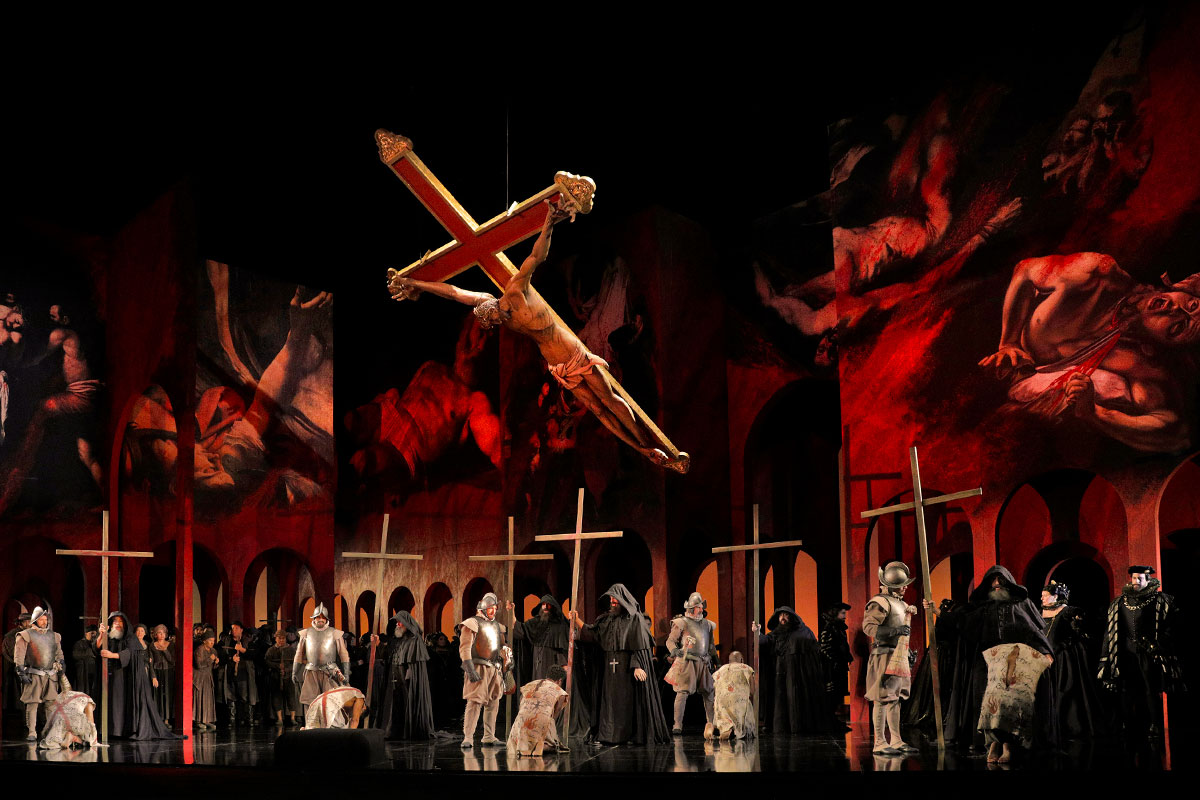
Through to the bottom of the cast list, a strong display of vocal talent came from members of the Domingo-Colburn-Stein Young Artist Program with Taylor Raven as Tebaldo, Joshua Wheeker as Count Lerma and Liv Redpath as the Celestial Voice. Further gifting the ear, a resonating swell of voices combined magnificently under Chorus Director Grant Gershon’s command, giving the processional Auto-da-fé scene tremendous grandeur - and it looked a menacing reminder as Christ on the Cross looked down in judgement - even though the scene’s realisation looked static.


Ramón Vargas as Carlo and Ana María Martínez as Elizabeth
Most, but not all, the action percolated with vision under revival director Louisa Muller but dotted stand-and-deliver performances detracted from this sensationally dark and brooding production. Whether inspired by the cut first act of Verdi’s revised long 5-act version or not, in which Elizabeth meets Carlo in the forest of Fontainebleau, John Gunter’s set cleverly features a forest of arches painted in blood red that provide a multitude of spatial arrangements. But apart from little more than the King’s desk, furnishings are non-existent, reducing action to mostly standing position. Black strikingly dominates Tim Goodchild’s sumptuous period costumes and Rick Fisher’s lighting added much to the intrigue.

In the pit, with the LA Opera orchestra sounding so wonderfully primed, conductor James Conlon demonstrated an eagerness to provide pronounced contrasts between the majestically thunderous and delicately threaded parts of the score, though often punctuating it at the expense of overall cohesive flow. Nonetheless, after a rather tepid first act, the dramatic heft was never in doubt and the singer’s were supported gloriously. 

In all but it’s puzzling ghost of Carlo V ending - and it fell noticeably flat on an audience seemingly unsure if it was over - Don Carlos looked and sounded the masterpiece it can be. A little more directorial vigour, however, would help to light it up superbly. 


Don Carlos 
Los Angeles Opera 
Dorothy Chandler Pavilion, LA Music Centre
Until 14th October, 2018.


Production Photos: Cory Weaver

Wednesday, September 19, 2018

Emma Matthews' world-class performance lights a torch for opera in The Space Between at Arts Centre Melbourne


Two years have passed since the premiere of composer and pianist Paul Grabowsky and librettist Steve Vizard’s Banquet of Secrets, a Victorian Opera commission I reviewed as “...an intricate journey of emotional impact delivered with a sense of sleek operatic approachability.” In a sense, the same could be said for their latest collaboration in a work commissioned by Arts Centre Melbourne, The Space Between. It’s a pleasure to have them back. So, too, it is to relish being up close to one of Australia’s all-time greatest and highly acclaimed sopranos, Emma Matthews. 

Emma Matthews in The Space Between
The Space Between, written with Matthews in the spotlight, is an inventive and absorbing 70-minute one-woman show in the form of an eclectic song cycle, assisted by Leticia Caceres’ vivid direction. Matthews sells it with excellence in nothing less than a world-class performance. Since taking on Head of Classical Voice and Opera Studies at the Western Australian Academy of Performing Arts, Matthews’ stage appearances are sadly rarer but that plush, lively and nurturing soprano sound you wish you could bottle hasn’t faltered. 

Beginning, dressed in a flouncy, flesh-toned period gown as the emotionally fraught and powerless Lucia from Donizetti’s Lucia di Lammermoor, Matthews launches into the cadenza of the opera’s terrifying “Mad Scene”, one she knows ever so well, with captivating virtuosity. When the final top note is taken over and electronically mimicked, so begins the journey with Matthews into an existential abyss. In the space between the notes there is so much more to contemplate in this powerful and personal exposition.

While not being completely biographical, the work explores memories and emotions as an opera singer in what is an ode to the operatic heroine. Vizard’s libretto is often poetic and searching while Matthews’ delivery is always intoxicating and dramatically driven. Questions and observations are at its core, reflected by such lines as “How can it be that I am here?”, “Where is love?”, “The conditions of life are utterly fragile.” and “I will live and keep on living”.  

If questions are elicited by the audience, there are no answers. If you’re lost, that’s fine as well because you’re still there in the moment, which Vizard makes reference to in the text. And Matthews is there tirelessly throughout, inviting her audience into her world and engaging with ease as she covers the stage and a range of emotion with unerring energetic flair. Pathos, heartbreak, anger and resilience are evident but their dark colours are also cleverly contrasted with wit and light-heartedness, as seen in a little music lesson in which Matthews animates her singing teacher espousing, “The music is before the note, between the note, around the note...”

Emma Matthews in The Space Between
Relying on piano, violin, cello, percussion, saxophone and recorded sound, the score is rich in variety, mood and creativity. Grabowsky, at piano to one side, has fashioned a complex, often eerie soundscape that rather beautifully bridges influences such as the atonal music of Alban Berg, the repetitive hypnotic rhythms of Phillip Glass, of folk, jazz and lounge music. Expertly mellow on saxophone, Jamie Oehlers makes occasional moves into Matthews’ space with the other musicians performing behind long lengths of translucent sheets. Roy Theaker’s violin work especially stood out. 

Vocal lines meet and depart from the music with exciting results and it’s challenges are comfortably realised. Most impressive is the way in which Matthews’ signature coloratura eloquence makes a leap into contemporary music-making territory. I’m confident I wouldn’t be alone in wishing back such operatic vocal splendour as more and more a part of modern composition.

The performance unfolds fluidly on set and costume designers Esther and Rebecca Hayes’ centrally placed oblique arrangement of steps, platform and ramp that provide ample scope for Matthews to utilise. Touching subtlety is achieved with Nick Schlieper’s superb lighting. 

It was a busy Wednesday evening at Arts Centre Melbourne. The Australian Ballet’s bold production of Spartacus danced across the stage of the enormous State Theatre. Jakop Ahlbom’s homage to the horror movie genre, Horror, would terrify audiences at the Playhouse Theatre. But at the smaller Fairfax Theatre, a little collaborative work lit a torch on the possibilities for the seductive sound of the operatic voice. And if Emma Matthews isn't nominated again for a Green Room Award, I'll make the assumption the panel were absent.


The Space Between
An Arts Centre Melbourne commision
Fairfax Theatre, Arts Centre Melbourne 
Until 23rd September, 2018


Production Photos: Mark Gambino

Tuesday, September 18, 2018

An astonishing queen and a formidable rival burn the stage in a spectacular Roberto Devereux at San Francisco Opera


Via history, literature and art, Elizabeth I ranks as one of the most recognisable monarchs to reign over England and its dominions. In opera, she makes several appearances, most notably in Donizetti’s bel canto spectacular, Roberto Devereux, non-evident in the title but one of a trilogy of operas now referred to as “The Three Donizetti Queens” or “The Tudor Trilogy” that includes Anna Bolena and Maria Stuarda. Little light filters through the plot that concerns Elizabeth’s obsession with the Earl of Essex, Robert Devereux, but in its musical language the exhilarating force of the bel canto style soars radiantly high. And it does so with monumental beauty in San Francisco Opera’s current season at the War Memorial Opera House.

Scene from San Francisco Opera's Roberto Devereux
Roberto Devereux is a multifaceted tragedy of personal desire, suspicion, betrayal and vengeance. English director Stephen Lawless’ angle brings a refreshing theatrical surprise and novelty to the stage without trivialising the gravitas that underlies the work. Making use of the melodic overture, which includes a tributary snippet of “God Save the Queen”, Lawless energises the work without delay as part of Benoît Dugardyn’s handsome set design - a sturdily built timber form mimicking London’s original Globe Theatre. This make-believe world of a stage within a stage concept serves well as a reminder that facts and truths easily evaporate in the service of artistic and dramatic license, as is the case here in Donizetti and his librettist Cammarano’s work. 

An elderly Elizabeth enters and a whirling unfurling of memories begin around her. Vitrines appear, containing herself as a child between her bickering parents Henry VIII and Anne Boleyn. Shakespeare pops out of a basket, a ballet sequence slots in delightfully and cut-outs of miniaturised battle ships cross the stage while surtitles give a little history lesson above. Lawless cleverly gives the immediate sense that we are firmly planted in Elizabeth’s domain and it’s from her perspective that we’ll be looking.


Sondra Radvanovsky (centre) as Elizabeth I
Even before making an impressive launch into her opening cavatina, star soprano Sondra Radvanovsky, who sang the role in this Canadian Opera Company production in 2014, revealed just how engrossing and committed she is as an actor. While exuding imperiousness in her royal duties, it was in the personal distraction of Elizabeth’s obsession with Devereux, the physical fragility, fidgeting and the deeply engraved facial expressions that Radvanovsky brought unforgettable stature to her role. Most poignant, even heartbreaking, was the uncertainty and conflict Elizabeth encountered not as ruler, but as a woman. After having signed the execution order for the man she regrettably sent to his death, Elizabeth’s ‘performance’ was over. In a dressing-room-like setting, the regal attire hangs over the dresser and Elizabeth appears in her undergarments - wig-less, disoriented and unfulfilled as a woman. Then, before all, Radvanovsky delivered an astonishing showcase of vocal heights in the finale aria, “Vivi, ingrate.”

In this, the third of a six performance run, Radvanovsky glistened with supreme beauty in the top range while showing off her flexibility and striking steeliness. There were early issues getting the lower range to meat-up but Radvanovsky’s command of the immediate drama remained unwavering. With exciting trills and ornamentations, Radvanovsky sensibly exuded elegance rather than flamboyance, uncannily able to convey meaning as if rendered in naturally spoken text - a first rate performance!


Jamie Barton as Sara, Duchess of Nottingham
As the married Sara, Duchess of Nottingham and Elizabeth’s rival for Devereux’s affection, mezzo-soprano Jamie Barton was on fire all night and was every bit as splendid in voice as her queen. Every part of the voice burned formidably and every emotion released with it seemed both heartfelt and real. Getting carried away as you do, Barton’s vocal qualities resembled a sensational dessert of stewed richness blended with soft, velvety textures and warm caramel. You simply wanted more.

Against these two powerhouse performances, both of which were large in theatrical gesture, the men by no means lacked presence - for a start, Ingeborg Bernerth’s highly detailed period costumes provided distinguished authority. And the men’s more subdued acting style certainly assisted in drawing more attention to the psychological trajectory of the women. American tenor Russell Thomas’ did the job smartly and robustly in the title role, the smoothness, resonance and clarity of his voice imparting genuineness and intent. Of significance, Thomas played his part with great sensitivity and understanding in his various duets with Radvanovsky and Barton. But the best of Thomas’ performance came in his final aria, “Come uno spirto angelico...” when, behind the bars of his cell, he sang achingly of Devereux’ refusal to betray Sara. 


Russell Thomas as Roberto Devereux
Romanian-American baritone and Adler Fellow Andrew Manea, who replaced Artur Rucinski, gave a strong-looking performance as the Duke of Nottingham though the depth of vocal colours was limited. The promise in the voice came in the shocking closing first scene of Act 3. In Sara's apartments, Nottingham pushes her to the bed in what no doubt will result in her rape and a great rush of adrenaline charged the voice in Manea’s finest moment. In the smaller roles of Lord Cecil and Walter Raleigh, Adler Fellow colleagues Amitai Pati and Christian Pursell were greatly satisfying and coercive, the men’s chorus less so with their often smudgy singing. 

The San Francisco Opera Orchestra were in superb form and conductor Riccardo Frizza led a marvellously measured interpretation that elevated the passions, the tension and occasions of pomposity throughout while giving the singers ample space to amplify.

It’s taken almost 40 years for Roberto Devereux to return to the San Francisco Opera. For this masterful production just three performances remain. If you have any slight interest in opera, get yourself a ticket because I’d hate to think you’d have to wait another 40 years to see it on stage again.


Roberto Devereux 
San Francisco Opera 
War Memorial Opera House
Until 27th September, 2018


Production Photos: Cory Weaver

Friday, September 7, 2018

From Gertrude Opera, Heggie's To Hell and Back resonates with its near claustrophobic experience of joyless life.


In just 40 minutes, within the intimate space of St Kilda’s Theatre Works, the ugly reality of spousal abuse was told in confronting and unsettling form on Wednesday evening. Presented by Gertrude Opera, American composer Jake Heggie’s one act opera, To Hell and Back, swings a powerful punch that leaves a lasting impression. Commissioned by San Francisco-based Philharmonia Baroque Orchestra, Heggie’s work premiered in 2006 in Palo Alto, and received its Australian premiere courtesy of Gertrude Opera two years ago at the short-lived Nagambie Lakes Opera Festival. 

Desiree Frahn as Stephanie and Dimity Shepherd as Anne
As they did back then, two wonderful exponents of opera cut and carved a deeply expressive and harrowing account of male brutality - soprano Desiree Frahn as the young abused wife Stephanie and mezzo-soprano Dimity Shepherd as the mother-in-law Anne. Together, they share the stage in an affecting, rapidly paced and near claustrophobic experience of joyless life. 

Frahn channels the pain, the bruises and dilemma Stephanie suffers in domestic spousal abuse yet denies herself the label of victim. Stephanie ponders, “How does a girl of dreams become the Queen of Hell?” and Frahn gives her agonising life,  singing radiantly through a broad range full of emotiveness, notably fine top notes and a purity that demands one’s sympathy. 

Dimity Shepherd makes it appear effortless in portraying Anne with a hardiness and matter-of-factness melded with a supportive heart, her voice luscious of tone and striking in depth. These two artists captivated with the synergy they created, demonstrated in the work’s high proportion of duet. Pivotally, Gene Scheer’s tight libretto keeps the perpetrator out of sight, giving him neither the time of day nor a voice to commend. 

Desiree Frahn as Stephanie and Dimity Shepherd as Anne
Heggie wrote this 5-part fluidly moving work for period instruments, including harpsichord. In this reduced piano version with Brian Castles-Onion as music director, pianist Peter Baker plays with stridency but what felt lacking was the heavy-bearing bass and lushness of sound that would have intensified the hellish mood. 

Greg Carroll’s poignantly drawn direction makes occasional steps out of realism  into a stylistic rendering that verges on poised dance. On a raised square base, Peter Corrigan’s design features a white-high curtained ‘wall’ on three sides and little more than two simple chairs. Intended or not, in its scale, I had thoughts of a boxing ring come to mind - two women within it fighting their predicament with a man who is rupturing their lives. Simple spring frocks carrying bold floral designs draw on the women’s shared time gardening.

In the end it comes as a shock when Anne tells Stephanie never to call/see her again. It seems a cruel blow after what appeared to be a tenderness she gave her in support as a confidante. If we look back at the garden scene, however, we find a hint there when Anne talks of giving seeds space and roots room to grow. Released from torment, a message of hope for a brighter future unfolds. What’s left to address is educating society that no room exists for domestic violence.


To Hell and Back
Gertrude Opera 
Theatre Works, St Kilda
Until 9th October 


Production Photos: